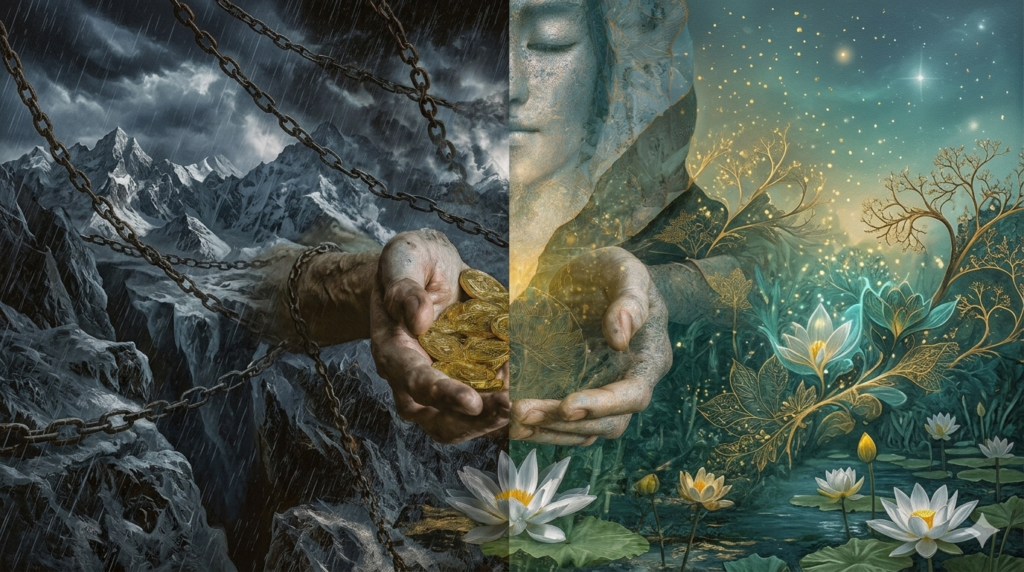
One of the most misunderstood concepts people struggle with is self love vs selfishness — and ironically, this confusion creates two opposite problems.
Selfish people rarely recognise their selfishness because they often mistake it for self-care or self-respect. At the same time, people who genuinely practice self-love frequently fear being labelled selfish.
The truth is simple:
Selfishness creates imbalance. Self-love embraces balance.
To truly understand the difference, we need to go beyond definitions and explore the core psychology and energy behind both concepts.
What Is Selfishness?
When you hear the word “selfishness,” who comes to your mind?
If you are around thirty years old, you may remember a classmate from your school days — the one who always wanted more marks, more appreciation, more attention, more recognition. The person who hated sharing.
If you are around forty-five or above, you may be thinking of a relative who always thinks about themselves first, excessively concerned about money, property, status, or fame.
But have you ever wondered: what is the core emotion behind selfishness?
At its root, selfishness is powered by two forces: fear and greed.
A selfish person is not necessarily a bad person. More often, they are a person who has lost their natural sense of balance. They develop a deep-rooted belief that life becomes better only when they possess more than what is sufficient — more money, more love, more attention, more food, more validation.
Anything beyond sufficiency begins to feel like safety.
But why? Because underneath greed lies fear.
Fear of being weak. Fear of being insignificant. Fear of criticism. Fear of uncertainty. Fear of simply being themselves.
Because of these fears, they become excessively focused on gathering and accumulating — whether those things are possessions, relationships, achievements, or emotional validation.
This excessive need for validation is something we explored deeply in the blog on toxic relationships — where the same fear drives people to seek approval from others at the cost of their own peace.
Where Does This Fear Come From?
As I have explained in my earlier blogs, most fears originate from conditioning.
Society conditions us. Families condition us. Religious beliefs condition us.
Conditioning itself is not the problem. In many ways, it exists to help society function with less chaos and conflict. The problem begins when we mistake these conditionings for absolute truths and permanently build our identity around them.
Over time, these borrowed beliefs become deeply rooted. They start creating internal pressure and fear. Eventually, fear gives birth to greed.
For perfectionists and selfish personalities, the cycle looks like this:
Fear creates greed. Greed creates stress. Stress demands more accumulation. More accumulation feeds greed. Greed strengthens fear.
An endless loop. A trap.
Most selfish people remain stuck in this cycle for decades — sometimes for their entire lives.
How Selfishness Disturbs Energetic Balance
Selfishness disturbs one of the most fundamental principles of existence: the law of energetic balance.
Anything accumulated beyond its natural limit eventually sabotages itself.
Take protein as an example. We all know the importance of protein for the body. But what happens when it is consumed excessively? You may have heard of bodybuilders who suffered severe organ damage due to excessive supplements and protein intake. Something beneficial became destructive simply because it exceeded balance.
This principle applies to every aspect of life. Even love.
Excessive love often manifests as possessiveness. Any love that denies freedom eventually becomes possession.
Many people mistakenly glorify possessiveness without realising that it is often a product of selfishness.
Have you ever heard someone say, “The devil loves him”? No. You hear people say, “He is possessed by the devil.”
Because when anything takes away freedom and growth, it stops being love and starts becoming possession.
Excess, regardless of whether it appears positive or negative, eventually creates imbalance. That is the nature of selfishness.
What Takes Someone Out of Selfishness?
I can answer that with one word: Awakening.
Awakening is freedom from malicious beliefs. It is freedom from unconscious programming. It is freedom from misunderstandings inherited from society, family, religion, and our own distorted perceptions.
Awakening is not acquiring something new. It is unlearning what was never true.
Self Love vs Selfishness: How Awakening Creates the Difference
Once a person begins awakening, the process naturally evolves into self-love.
Self-love is not emotional indulgence. Self-love is not doing whatever feels good. Self-love is not seeking happiness at any cost.
In fact, a person practicing self-love gradually stops being enslaved by emotions.
A selfish person continuously feeds greed, fear, anger, and stress. Their entire existence revolves around chasing occasional moments of happiness. Without realising it, they become addicted to emotional highs.
But happiness itself is an emotion. And emotions, by nature, fluctuate.
A person practicing self-love understands this deeply. Their goal is not emotional intoxication. Their goal is peace.
Because peace and joyfulness are not emotions. They are states of being.
A person practicing self-love consciously chooses peace over emotional addiction. This is precisely what we explored in emotional intelligence — the ability to direct emotional energy toward growth rather than drain it through unchecked reactions.
When someone becomes devoted to peace and joyfulness, they naturally develop an understanding of balance. You will rarely find a deeply self-loving person who is impulsive and emotionally chaotic.
A person practicing self-love tends to become calm, centred, and quietly confident. A deep trust in life begins to emerge.
How Does a Person With Self-Love Function?
A person practicing self-love embraces their strengths and weaknesses. They believe in evolution. They invest their time in developing themselves and improving what they use.
They do not live merely to accumulate. They live to grow.
People often ask: “What about rich and poor people? Who is selfish and who practices self-love?”
The answer is more nuanced than it appears. Neither wealth nor poverty determines whether someone is selfish or self-loving.
There are selfish millionaires and awakened labourers. There are peaceful billionaires and emotionally impoverished people with very little money.
The real question is: Are you accumulating, or are you evolving?
Selfishness is obsessed with possession. Self-love is devoted to development.
A person practicing self-love focuses more on capabilities than acquisitions. They understand that possessions can disappear. Skills remain. Inner balance remains. Awareness remains.
Their identity does not depend on what they own. It depends on who they are becoming.
Because once we understand emotions and become less attached to emotional highs and lows, maintaining peace naturally becomes our priority.
And when peace becomes the priority, life becomes simpler. Choices become clearer. Moderation happens effortlessly. Balance becomes natural.
Only a person practicing self-love can genuinely nurture themselves.
And when the necessary moderation in life no longer feels forced but becomes a spontaneous expression of your being —
Congratulations. You have graduated in the practice of self-love.
— Jerry, Maverick Seer Hybrid Healer · NLP Practitioner · Energy Healing Expert
Are fear, greed, or emotional patterns quietly running your life? Through NLP, inner child healing, and energy healing, Jerry helps clients uncover the root of these patterns — and guide them toward the peace, balance, and self-love they deserve. Book your free 30-minute clarity call →