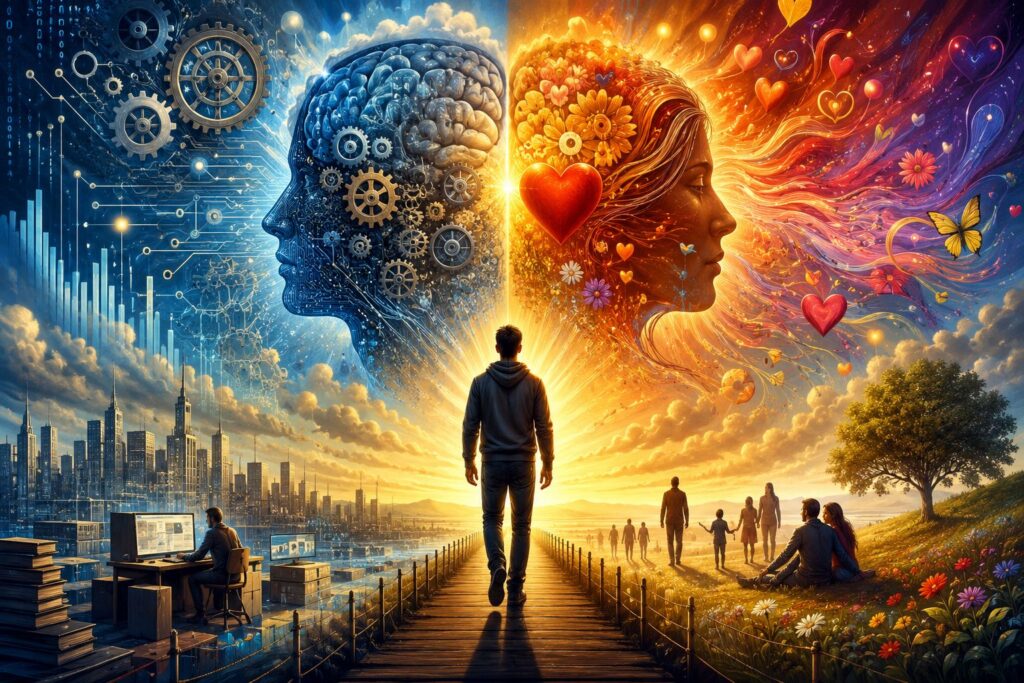
What is emotional intelligence — and why does it matter more today than ever before? Emotions and intelligence stand at opposite poles. One is fluid, unpredictable, and often overwhelming. The other is structured, measured, and analytical.
Now, what happens when these two opposites are combined?
Something extraordinary happens.
That extraordinary combination is called Emotional Intelligence.
And in today’s increasingly complex world, it might just be your greatest asset.
What Is Emotional Intelligence: Understanding Emotions First
Let us first understand emotions.
Emotions have a natural tendency to overflow.
Think about the moments when you felt deeply sad, incredibly happy, anxious, angry, or heartbroken. Did you ever calculate the exact point where those emotions would stop?
Probably not. Because emotions do not operate on logic. They are emotional by nature.
You cannot precisely predict how deeply you will feel, how long you will feel it, or how much energy it will consume.
This is also why many poor decisions are often called emotional decisions. Because when emotions become intense, our ability to think clearly becomes clouded.
Emotions themselves are not wrong. The problem begins when emotions start driving our decisions instead of simply informing them.
The Purpose of Intelligence
Now let us take a quick look at intelligence.
Why do human beings value intelligence so much? The answer is surprisingly simple.
Intelligence exists to conserve resources.
Every intelligent invention around you has one purpose — to reduce effort, to save time, to optimise resources.
Machines exist because we do not want to perform repetitive tasks manually. Technology exists because we want to achieve more with less effort.
Intelligence is essentially the art of efficiency.
What Happens When You Combine Emotions and Intelligence
It sounds difficult. Because emotions want expression. Intelligence wants regulation. Emotions want to react. Intelligence wants to respond. Emotions want to flow. Intelligence wants to direct.
But if these two forces can work together harmoniously, your life can transform in ways you never imagined.
A Real-Life Example: The Corporate Ladder
Imagine walking inside a multinational company. You have the opportunity to speak with everyone.
First, you meet the security guard. Within a few minutes, there is an emotional bond — family concerns, financial struggles, personal challenges. The emotional exchange happens quickly.
You walk further and meet the receptionist. The rapport still happens, but it is comparatively lesser.
Then someone from accounts. Again, more limited.
Then the General Manager. The conversations become tighter. More professional. More measured.
Finally, imagine meeting the Director of the company. The emotional expressions are often minimal.
Why? Is it because they attended some special business school that taught them not to feel emotions?
No.
It is because as responsibility increases, people naturally learn to regulate emotional expenditure.
When the stress load becomes enormous, uncontrolled emotions become extremely expensive. The people carrying heavy responsibilities gradually realise something most of us never consciously notice:
Emotions consume energy. And energy is a resource. A precious one.
The Energy Economy of Emotions
This is the insight I want every reader to take away from this article.
Every emotion consumes energy.
Whether it is happiness or sadness. Whether it is considered positive or negative. If it is an emotion, it consumes energy.
You can use your energy in two ways — to focus on creating the life you desire, or to continuously express and resonate with emotional experiences.
Now imagine that every human being receives 100 energy coins every single day.
The highly successful individuals often spend 80 to 90 coins on building their vision — learning, creating, solving problems, manifesting their dreams. The remaining coins go toward emotional experiences with family and friends.
Now look at the average person. Their energy expenditure is usually the reverse — 80 to 90 coins spent on worrying, overthinking, reliving old incidents, being offended, seeking validation, and managing emotional turbulence. The remaining few coins are used for pursuing goals.
Most of us fall somewhere in between these two extremes.
Building Awareness: The First Step Toward Emotional Intelligence
Awareness is simply the art of realisation.
Remember a moment when you became extremely emotional — angry, deeply hurt, or excessively excited.
Now answer honestly. Didn’t you feel drained afterwards?
Every single time.
The longer the emotion stays within you, the more energy it extracts from you. This is why emotional exhaustionexists.
Observe this carefully from today onward. Notice what happens after every emotional episode. Observe your energy levels. Observe your focus. Observe your productivity. Observe your inner peace.
You may discover something remarkable.
The emotion itself was not the problem. The duration of your attachment to it was.
The Hidden Danger of Repeated Emotions
There is another interesting observation.
The emotions we repeatedly resonate with begin influencing the kind of experiences we notice, focus on, and emotionally engage with.
When we stay angry, our attention naturally gravitates toward situations that trigger anger. When we remain fearful, our mind becomes highly sensitive to threats. When we constantly feel grateful and inspired, we become more aware of opportunities and possibilities.
In simple words: the emotional frequency you repeatedly occupy starts shaping your inner world and your perception of life.
This is deeply connected to how negative thoughts affect physical health — sustained emotional states don’t just affect the mind. They affect the body too.
Emotions Are Not Wrong
Let me make something absolutely clear.
I am not advocating emotional suppression. I am not saying emotions are bad.
I am simply saying: anything beyond balance eventually becomes harmful. Even water can become dangerous when it overflows.
Emotions should never operate without intelligence. They should always work together.
That balance is emotional intelligence.
The Emotional Intelligence Formula: A 3-Step Approach
I personally see emotional intelligence as a three-step adaptation process.
Step One: Understand the Concept (50%)
The first half of transformation happens simply by understanding one truth: emotions consume energy.
This realisation alone changes the way you experience life.
Step Two: Find Your Energy Leakages (25%)
Audit yourself. Ask:
- Which emotion haunts me the most?
- Which emotion repeatedly disturbs my peace?
- Which emotional state forces me to struggle harder than necessary?
Then ask: What incident first connected me to this emotion?
Perhaps it was rejection. Perhaps betrayal. Perhaps childhood experiences. Perhaps failure. Perhaps loss.
Begin working on detaching yourself from that emotional anchor. This process of detachment can completely transform your life.
Seeking help is perfectly acceptable — a psychologist, a hypnotherapist, a healer, a mentor. Whatever genuinely helps you heal and detach.
Once you gradually free yourself from those emotional anchors, you have already travelled nearly 75% of the journey toward emotional intelligence.
Step Three: Understand the Power of Directed Emotions (25%)
Every thought becomes powerful when accompanied by strong emotions.
Imagine your mind as a whiteboard. You write a thought on it. Then you invest emotional energy into it repeatedly and intentionally.
Over time, thoughts that consistently receive focused attention and emotional commitment begin influencing your actions, decisions, and persistence toward that goal.
Now imagine your whiteboard filled with hundreds of different thoughts. Your emotional energy becomes scattered. Your focus becomes divided. Your efforts become inconsistent. And progress slows down.
This is why it is often wise to maintain only one to three major goals at a time. Allow one or two to materialise before adding more.
Focus is not merely concentration. Focus is emotional energy directed intelligently.
The Final Thought
An emotionally intelligent person is not someone who has no emotions.
An emotionally intelligent person is someone who is never a victim of emotions.
They understand that lower emotions can become sources of energy leakage, and higher emotions can become powerful tools for inspiration and creation.
Life often becomes stuck not because we lack dreams. Most of us have dreams. Life becomes stuck because we misuse the very tools that were given to us to create those dreams. We exhaust ourselves emotionally and then wonder why we have no energy left to build our future.
Perhaps the greatest act of self-respect is learning where your emotional energy goes every single day.
Because your energy is your life.
And where your energy goes, your future follows.
From today onward, let us learn, practise, and retune our inner frequency by cultivating one of the most valuable skills of the modern world: emotional intelligence.
Because mastering your emotions is not about becoming less human. It is about becoming so aware of your inner energy that your emotions start serving your purpose instead of silently consuming it.
— Jerry, Maverick Seer Hybrid Healer · NLP Practitioner · Energy Healing Expert
Are unmanaged emotions draining your energy, focus, and sense of purpose? Through NLP, subconscious reprogramming, and energy healing, Jerry helps clients identify the emotional patterns consuming their energy — and rewire them at the root. Book your free 30-minute clarity call →