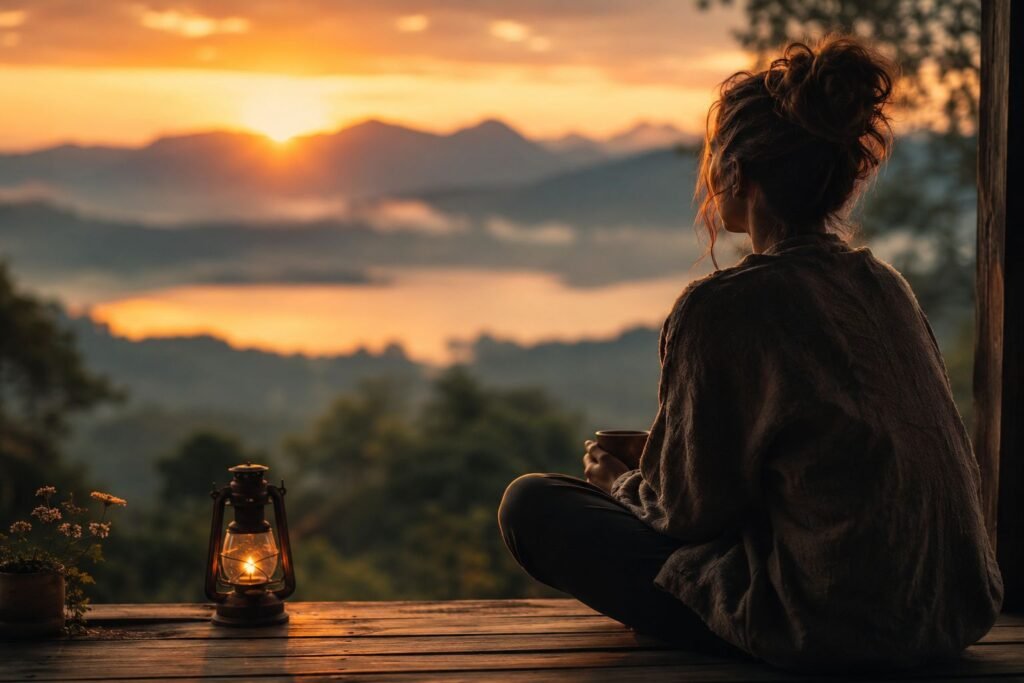
If you are wondering how to slow down in life, you are not alone — and the answer may begin somewhere you least expect it. Before we speak about the art of slowing down, I think it is important to understand three things: Why should we slow down? Where should we slow down? And when should we slow down?
Let us begin with the most essential aspect of our lives.
Breathing.
Because when breathing slows down, something profound happens within us.
A Different Way of Looking at Life
Have you ever noticed that the lifespan of a living being seems to have a relationship with the pace of its breathing?
Take the Galápagos Giant Tortoise for example.
A giant tortoise breathes approximately 4–5 times per minute.
Now think about a dog. A dog breathes anywhere between 15–40 times per minute.
Now compare their lifespans. A dog may live around 10–15 years. A giant tortoise can live for 100–150 years or even longer.
I am not presenting these facts to compare animals. I am simply inviting you to look at life through a different lens.
We all grew up hearing the story of the rabbit and the tortoise. Most of us were taught that the lesson was “slow and steady wins the race.”
But what if the lesson goes much deeper?
What if slowing down is not merely about winning a race?
What if slowing down is about experiencing life itself?
The Secret Hidden in Breath
There are yogis who have crossed the age of one hundred while remaining active, healthy, and capable of performing their daily activities with remarkable ease.
If you study their lives, their habits, and their teachings, one thing repeatedly appears: their breath is slow.
I know what many of you are thinking. “No, I cannot simply force myself to breathe slowly.”
And you’re right. Mechanically slowing down your breath is not the answer.
But what if your breathing naturally slows down when you begin experiencing life differently?
To understand this, we need to go back to the beginning.
The Breathing Style We Were Born With
Think about a baby less than a year old.
Have you ever watched a baby breathe? When they inhale, their tummy rises. When they exhale, their tummy falls. The entire breathing process is visible. Natural. Effortless. Complete.
This is how we were all designed to breathe.
But there is something even more beautiful about babies. They are constantly experiencing life. They observe everything with curiosity. Everything is fascinating. Everything is new. Everything is worthy of wonder.
Perhaps that is why everyone loves babies. When we look at them, we witness pure joy in its most natural form.
But somewhere along the journey of growing up, something changes.
The joy begins to fade.
And so does the breathing.
The Connection Between Emotions and Breath
As children grow, they are introduced to the four fundamental emotions: happiness, sadness, fear, and anger. As life continues, countless other emotions are added to the mix.
And with every emotional imprint, breathing changes.
Have you noticed your breathing when you’re angry? It becomes fast. Shallow. Restless.
Now think about moments when you’re deeply happy or peaceful. Your breathing naturally slows down. It becomes softer. Deeper. Calmer.
The relationship between breath and emotions is so intimate that one constantly influences the other.
People carrying chronic stress often breathe primarily through their chest. People living with greater ease and emotional balance often breathe deeper into their abdomen.
The breath tells a story. Sometimes a story we don’t even realize we’re telling.
Why Saints Observe Breath
Many people are fascinated by stories of saints and yogis predicting illnesses, life events, or even death. While some experiences may indeed be extraordinary, much of what appears mystical can sometimes be rooted in profound observation.
Breath reveals patterns.
A normal person may breathe around 15–21 times per minute. When breathing remains consistently elevated, it may indicate stress, imbalance, or a body under pressure.
This is why learning abdominal breathing can be so transformative. It is simple — expand the abdomen while inhaling, allow it to contract while exhaling.
For some, this may feel difficult initially. But with practice, it becomes natural.
And when breathing changes, life begins to change with it. Because once your breath slows down, you begin slowing down internally.
And suddenly, life feels different.
How to Slow Down in Life: Start With the Journey
Imagine you’re travelling somewhere. Usually, all attention is focused on reaching the destination.
But when you begin slowing down, something remarkable happens. You start enjoying the journey itself. The scenery. The sounds. The conversations. The moments between the moments.
You become less anxious about outcomes and more connected to experiences.
Perhaps this is why slowing down requires more unlearning than learning. It is not about acquiring another skill. It is about letting go of the constant urgency that society has normalized.
Slowing down is stepping out of the rat race. It is choosing authenticity over conformity. It is returning to yourself.
This same urgency often feeds overthinking — when the mind is always racing toward the next thing, it never truly rests.
The Toothbrush Lesson
Let’s look at something incredibly ordinary. Brushing your teeth.
Most people brush their teeth while thinking about something completely unrelated — tomorrow’s work, an argument, an unpaid bill, a social media notification. Almost nobody is actually present while brushing.
Now think about it. People have brushed their teeth every day for decades. Yet many still suffer enamel damage, gum problems, cavities, or root canals.
Why? Because the act became a ritual. Not an experience. Not a purposeful action.
Now imagine brushing with one clear intention: “I am brushing my teeth for the long-term health and life of my teeth.”
The moment purpose enters the action, something changes. You naturally slow down. You become precise. You become observant.
And surprisingly, you start enjoying the process.
The purpose transforms the experience.
Purpose Is What Slows Us Down
The art of slowing down is not about moving slower. It is about remembering why you are doing something in the first place.
Not the reward. Not the outcome. Not the applause.
But the purpose.
If you’re breathing, the purpose is experiencing the breath. If you’re brushing your teeth, the purpose is caring for your health. If you’re driving, the purpose is not merely reaching a destination — it is experiencing the drive itself.
This shift in perspective is at the heart of self-love — treating your own life as something worth being present for, rather than rushing through.
A Doctor’s Story
A doctor friend once shared something fascinating with me.
For years, he travelled the same route to the hospital. He loved driving and paid close attention to every aspect of the journey. Over time, something unusual began happening. Before starting the car, he often sensed where traffic would be heavy, where delays might occur, and where disruptions were likely. He couldn’t explain why. But he noticed it repeatedly.
As he spoke, I found myself smiling. Because I believed I understood what was happening.
When we perform an activity mindfully, the mind develops a deeper relationship with that experience. The mind begins collecting patterns we consciously overlook. It becomes a powerful servant.
And that is why so many masters throughout history have said: never let the mind become your master. Train it to become your servant.
The Artist Within
Art has never been about rewards.
A true artist creates because of the experience of creating. The painting is merely the outcome. The experience is the treasure.
And this is where the art of slowing down truly begins — it begins with valuing experience above achievement.
Even if you’re simply drinking a cup of tea. Feel the warmth touching your lips. Notice the flavour dancing on your taste buds. Observe it travelling down your throat. Feel the gentle warmth settling into your stomach. Notice the subtle shift in your mood.
Experience it. Really experience it.
Because life is not happening somewhere in the future.
Life is happening now.
The Invitation — How to Slow Down in Life, Starting Today
When you slow your breath… when you embrace the beauty of experiencing… when you stop measuring life solely through achievements… the artist within you awakens.
And the natural consequence is simple. You begin slowing down. Not because someone told you to. But because life becomes too beautiful to rush through.
So start with your breath. Then move to the areas of life where you feel the greatest urgency. Practice slowing down. Practice experiencing. Practice being present.
Because what is the point of reaching the end of life… if you never truly experienced living?
Slow down. Embrace each moment. Experience every breath.
Because you only get one opportunity to be you.
And that opportunity is happening right now.
Never compromise your life for a rat race.
Slow down. And finally, begin to live.
— Jerry, Maverick Seer Hybrid Healer · NLP Practitioner · Energy Healing Expert
Does the pace of life feel overwhelming — leaving you anxious, exhausted, or disconnected from yourself? Through NLP, breathwork awareness, and energy healing, Jerry helps clients release the patterns of urgency, stress, and chronic mental noise — and return to a life that feels genuinely lived. Book your free 30-minute clarity call →